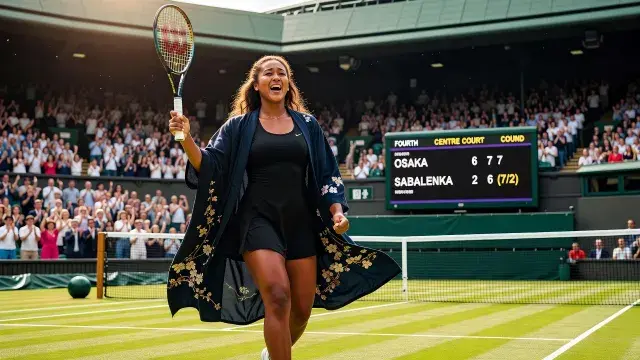
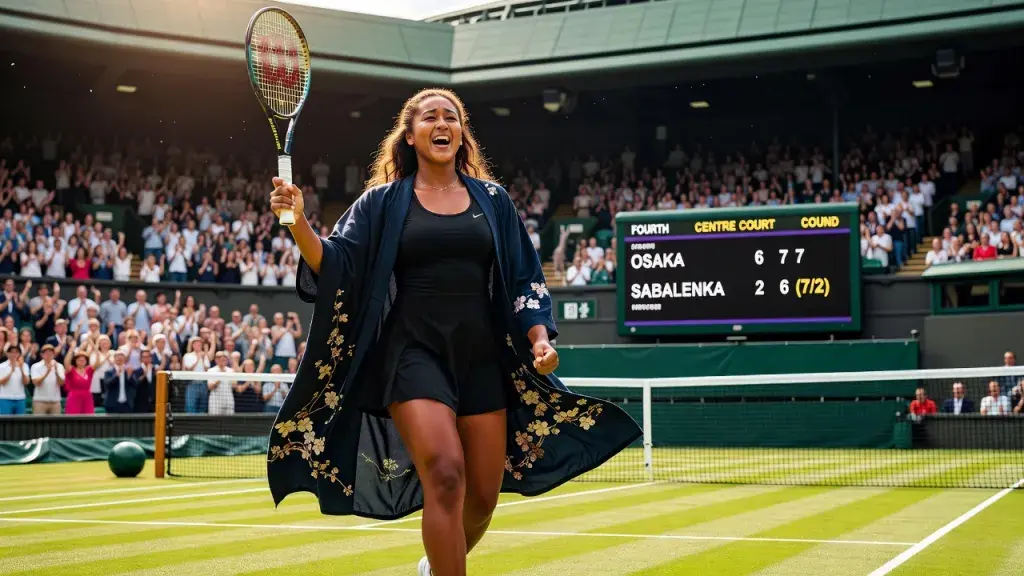
Naomi Osaka delivered the performance of her resurgent career on Sunday, dismantling world number one Aryna Sabalenka 6-2, 7-6 (7/2) on Centre Court to reach the Wimbledon quarter-finals for the very first time. The 14th seed was relentless from first ball to last, avenging three consecutive defeats to the Belarusian in 2026 alone and ending Sabalenka's tournament at the last-16 stage. It was a result that reverberated across the draw and confirmed that Osaka, five years removed from her last Grand Slam title, is genuinely back among the contenders at the sport's biggest stages.
The victory carries the weight of a genuine comeback story. At 28, Osaka has rebuilt her game under coach Tomasz Wiktorowski - the man who guided Iga Swiatek to the top of the world rankings - and the results have followed with gathering pace. A semi-final run at the US Open last year laid the groundwork; an unblemished run of four sets won from four matches here at Wimbledon confirms the trajectory is real. For fans following her return closely and tracking her form across surfaces, platforms like Sapphire Bet have been reflecting just how sharply the market's view of Osaka has shifted over recent weeks, as her grass-court credentials have grown with each passing round.
Osaka had beaten Sabalenka only once before in their head-to-head, yet on Sunday she played with a clarity and conviction that made the outcome feel inevitable from the midpoint of the first set. She broke in the third game with a blistering backhand that fizzed past her opponent, then kept the pressure relentless from the baseline. Sabalenka, notorious for losing her composure in difficult conditions, let out an anguished scream after being broken a second time in the opener and stormed off court for a break before the second set. The wind on Centre Court played its part in unsettling the Belarusian, who was never able to find the rhythm that has underpinned her dominance on the Tour for the past three seasons.
Tie-Break Triumph Ends Sabalenka's Unbeaten Run
The second set tested Osaka in ways the first had not. Sabalenka steadied, and the contest tightened into a genuine battle of nerves as the set pushed to a tie-break. What made the denouement remarkable was the context: Sabalenka had won her last 21 Grand Slam tie-breaks, a statistic that speaks to the composure she normally produces in the sport's highest-leverage moments. Osaka was unfazed. She powered through the tiebreak 7-2, winning it with the kind of clean, aggressive ball-striking that has been the hallmark of her fortnight. It was also the first time Osaka had won a match on Centre Court, a detail she acknowledged with visible emotion afterwards. "For me this court is so special," she said. "This is the first match I've won on this court. It means a lot."
Fashion, Fun and a Mother's Cooking
Osaka has brought something else to Wimbledon this year beyond tennis: a sense of occasion and personality that the tournament rarely sees. Her walk-on outfits - a kimono, a bomber jacket with a long train, a cloak styled after an open kimono - have generated as much conversation as her matches, and the player herself believes the attention has served a purpose. With the spotlight on her wardrobe, the scrutiny on her game has felt lighter. "It's been a long time since I've had so much fun on the court," she said after Sunday's victory. She also credited an unlikely source of energy: her mother's home cooking. Watching from the players' box, her mother has been preparing Japanese food throughout the tournament. "I feel like her cooking is powering me," Osaka said. "I would like another meal tonight."
Muchova Next as Osaka Eyes Semi-Finals
Sabalenka departs Wimbledon having never reached the final here, with three successive semi-final exits now on her record at SW19. The loss follows her surprise quarter-final defeat to Diana Shnaider at Roland Garros, raising questions about her capacity to hold it together at the business end of Slams despite her dominance across the regular season. She remains the best player in the world by ranking, but the grass has consistently exposed a fragility that her all-court game cannot always paper over. For Osaka, the road ahead leads to Czech tenth seed Karolína Muchová, a player of considerable guile and variety who will provide a markedly different challenge. Osaka has not dropped a set in four matches. Whether she can maintain that level against a player as tactically inventive as Muchová will define whether this Wimbledon run becomes something truly historic.