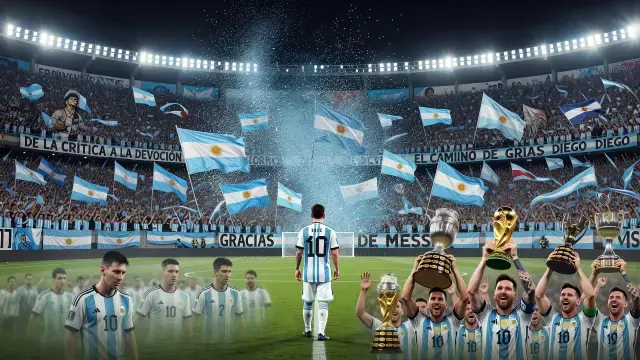
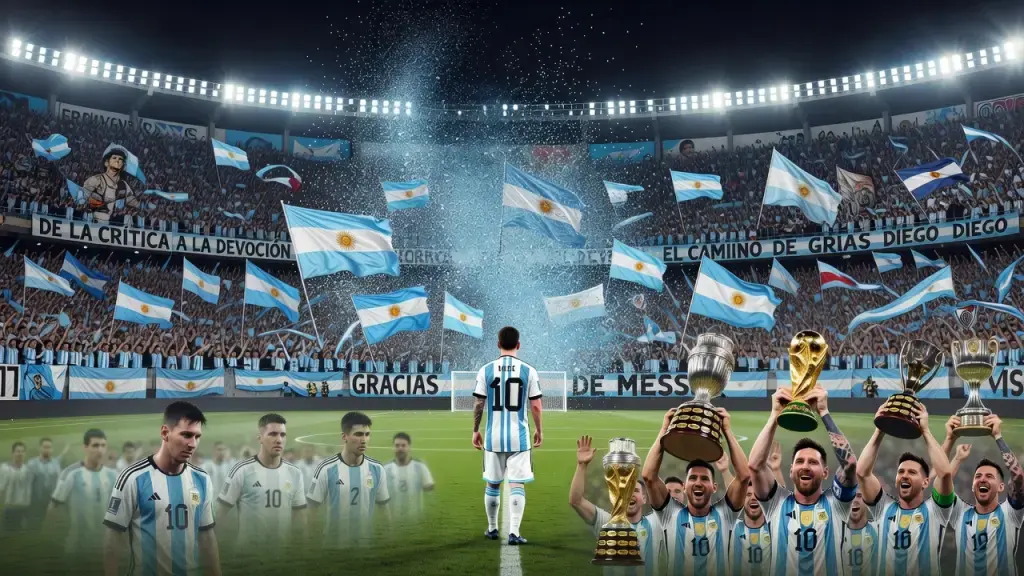
BUENOS AIRES - Lionel Messi will play his 208th and final match for Argentina on Tuesday evening at River Plate's Estadio Monumental, a friendly against Benin that closes out one of the strangest love stories in football history. It is worth asking what would have happened in almost any other footballing nation had it been handed, at 18, a player many now consider the greatest of all time. In Argentina, the answer for years was criticism, suspicion, and even boos.
A Gift Argentina Was Slow to Embrace
Messi left Rosario for Barcelona at 13, in September 2000, with no guarantees of success. He won over the Spanish club through ability and persistence, supported by his father Jorge. His rise in Europe coincided with Argentina's devastating 2001-02 economic crisis, a period that left the country clinging tightly to its existing heroes - chief among them Diego Maradona. For a long stretch, that comparison worked against Messi rather than for him. Critics back home insisted he was a product of a softer European game, untested by the physicality of the Copa Libertadores, even as the likes of Fabio Capello were privately trying to sign him for Juventus after a single pre-season glimpse of his talent. kingmaker casino withdrawal
Two Messis, Two Countries
For much of his career, Messi lived a split existence: adored abroad, scrutinised at home. Never having played for an Argentine club counted against him domestically, even as his reputation grew unstoppably elsewhere. Argentine writer and philosopher Tomas Abraham argues the divide went beyond football, pointing to political undertones tied to Peronism's attachment to Maradona. Messi, by contrast, avoided political statements almost entirely - refusing to back Catalan independence in Barcelona, and later skipping Joe Biden's Presidential Medal of Freedom ceremony in January 2025 before appearing warmly alongside Donald Trump at the White House in March 2026, one of the rare moments he took a visible side.
From Boos in Santa Fe to Six Million on the Streets
The low point came after Argentina's 2011 Copa America quarter-final exit on home soil, when fans in Santa Fe booed Messi off - a reception he had previously only experienced at the Bernabeu. Defeats in the 2014 World Cup final and the 2015 and 2016 Copa America finals deepened the narrative of a player who couldn't replicate his club form for the national team. Pundit Ariel Senosiain and journalist Marcelo Gantman both point to a media and fanbase shaped by 28 years without a trophy, searching for a scapegoat in a player who didn't fit the Maradona mould.
A Rewritten Ending
The turnaround began with the 2019 Copa America semi-final run and crystallised with the 2021 Copa America title over Brazil at the Maracana. Victory in the Finalissima, the 2022 World Cup, another Copa America in 2024, and the 2026 World Cup followed in rapid succession. When Argentina celebrated the 2022 title, five to six million people filled Buenos Aires' streets - more than a tenth of the country's population - a spontaneous, unified embrace that finally closed the gap between Messi and the nation that had taken so long to claim him as its own.